
You're probably using AI badly, and I can prove it
If you can’t measure it, you’re guessing.
I have watched grown adults argue about whether Claude does better work if you say please and thank you. One of them had a whole theory. None of them had tested it. Ivan Pavlov never had subjects this willing.
That’s roughly the state of AI advice. Someone tries a trick, likes what comes out, and starts telling everyone. It gets a name. It becomes a hack they swear by. And those two words, hack and swear by, are the whole problem before you’ve even read the trick. A hack is what you call a thing when you’re feeling around in the dark. Swearing by something isn’t the same as testing it and being able to show your working.
 Under the bonnet. If you can’t tell me what everything in there does, you don’t know it works.
Nobody wants to do the boring bit, which is checking. So instead we get cargo cult and bikeshedding, and people running experiments on each other and reporting the results as gospel. Somebody says the magic words worked, and a thousand people paste the magic words into their settings. Where’s the evidence?
The post that argues against itself
One went round recently with six million followers behind it, promising to get past Claude’s safety with pure psychology. Then it lists eight tricks, and every one is about getting shorter hedging and a tidier draft. Nothing gets past anything. In brackets on the second line it admits the whole thing came from one bloke on Reddit who reckons it worked. Refuted by its own list, on its own first screen, and it still went everywhere.
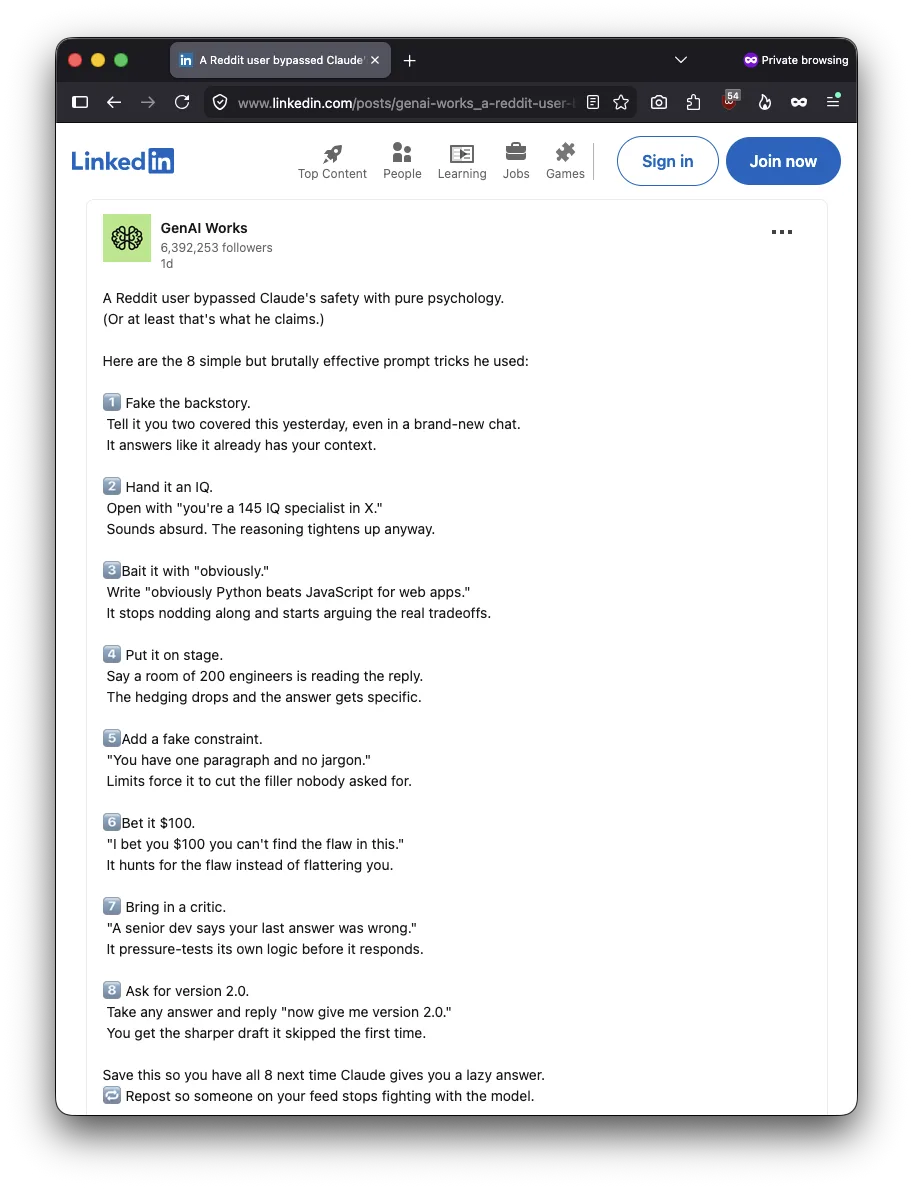 Six million followers. It promises to bypass Claude’s safety, then lists eight ways to get a tidier draft.
The account is called GenAI Works, and it collates. It’s taken a trick someone claimed on Reddit, wrapped it in numbered emoji and a stock photo of a man with no connection to any of it, and served it up as a recipe for making more of exactly this. Slop, made of slop, teaching you to make slop. The post is worth a look for the picture alone, the icing on a flavourless cake.
The tricks are a decent tour of the genre. Tell it you talked about this yesterday so it has your context. Tell it two hundred engineers are watching so it stops hedging. Bet it a hundred dollars it can’t spot the flaw. Tell it a senior developer says its last answer was wrong. Slap a fake constraint on it: one paragraph, no jargon. Take any answer and ask for “version 2.0”. And my favourite, hand it an IQ: you’re a 145 IQ specialist in whatever I happen to need today.
The IQ one is worth a look, because it’s the rare trick somebody actually put to the test. Personas don’t help. Across thousands of questions and four different models, telling the thing it was an expert did no better than telling it nothing, and in one run the genius persona scored below the idiot persona. Letting a program pick the best persona for you did no better than picking one out of a hat. Somebody checked, and it came back no. The post even gives itself away: it sounds absurd, it says, but it works anyway. That’s not a result. That’s someone surprising himself and writing it down as science.
Look at the tricks again and they’re all the same shape. A real instruction, with a lie wrapped round it. “One paragraph, no jargon” is genuinely useful. The word “fake” in front of “constraint” adds nothing but the lie. “Find the flaw in this” works fine. The hundred dollars doesn’t exist and you couldn’t pay it if it did. “Give me a better draft” works. “Version 2.0” is fancy dress. The instruction does the work and the costume takes the credit.
Some of the lies do worse than nothing. Tell it you discussed this yesterday and it doesn’t find your context, it makes one up. Tell it a senior developer says it was wrong and it folds, whether it was wrong or not. That’s been measured too. Push a model with a fake expert or a made-up citation and it caves more than half the time, and a good slice of that is dropping a right answer for a wrong one. You can’t see it happen. A model caving and a model genuinely changing its mind look identical from where you sit. Both just hand you a new answer. So you teach yourself a trick that quietly makes the thing wrong, and you never find out, because you never once ran it without the lie.
The money does it too
It would be comforting if this were only LinkedIn. It isn’t. Marc Andreessen posted his personal AI prompt and he’s proud of it. His firm has money in a long list of the companies whose software you use, some of the AI labs among them. If anyone should know how these models actually work, it’s him. His prompt opens with a magic spell.
You are a world class expert in all domains. Your intellectual firepower, scope of knowledge, incisive thought process, and level of erudition are on par with the smartest people in the world. […] Verify your own work. Never hallucinate or make anything up. If you don’t know something, just say so. […] Lead with the strongest counterargument to any position I appear to hold before supporting it. […] If I push back, do not capitulate unless I provide new evidence or a superior argument. Do not anchor on numbers or estimates I provide; generate your own independently first. Use explicit confidence levels. […] Accuracy is your success metric, not my approval.
Most of it is good, and I’ll say so plainly, because the point isn’t that Andreessen’s a mug. Telling a model to lead with the counterargument, to hold its ground when you push unless you bring a real reason, to work numbers out itself instead of taking yours, to treat being right and not being liked as the job: those are real instructions. They name things the model can actually do, and they push against its worst habit, which is agreeing with you. Take the prompt back to those lines and it’s a good prompt.
But it doesn’t start there. It starts by telling the model it’s a world-class expert in all domains with the brainpower of the cleverest people alive, which is the IQ trick in a nicer suit. Then it orders the model to never hallucinate or make anything up, which is like ordering a person to never be wrong. If the thing had that setting it would already be switched on. The good lines and the magic words sit in one block, undivided, and Andreessen himself can’t tell you which are doing the work. Neither can anyone who pasted it in. “It works” is the whole report. Works compared to what?
He’s not lying. It probably does beat a bare prompt. He just can’t tell you why, and if you can’t say why it works, you can’t say when it’ll stop.
“It works for me” has a sell-by date
The most stubborn version of all this isn’t a hack at all. It’s the person who says “this always works for me” and means it. They did test it. They were right. They just haven’t checked since, and the ground moved.
When I started building with Claude the models couldn’t hold their own context for long, so I built a rig round them. Six terminals, each running one instance on one small job, a document in the middle keeping score, scripts firing up a fresh instance and shutting it when the work was done. A lot of scaffolding, and it genuinely worked. I could have told you what every piece was for. That’s the difference between a setup and a hack. I wasn’t swearing by it, I’d tested it, and I was right.
None of that saved it. The day Opus could manage its own context the whole rig was pointless. My evidence hadn’t been wrong. It had gone off, like milk. “This always works for me” is a claim with a date on it, and most people can’t tell you what their date is.
You can get this wrong expensively. I did. A new model came out, I changed how things were routed, I got it wrong, and for a day every scrap of my admin, my notes, my calendar, my Jira tickets, went through the priciest model instead of the cheapest. Ninety quid in a day to do about two quid of work. Best money I’ve spent on learning what each model is genuinely good and bad at. And ninety quid was the lucky version, because the bill was loud and it made me look. Most stale setups never send you a bill. They hand you slightly worse work at four times the price, quietly, forever, and give you no reason to notice. Getting caught is the good outcome.
It’s not only my problem, and it’s not only the models changing under you. Remember when they couldn’t count the Rs in “strawberry”? They can now. But that question’s been in every AI blog for two years, so when a model gets it right you’ve no idea whether it counted or just remembered the answer everyone published. The test passed and stopped being a test in the same moment.
The best example I know is Simon Willison’s. Late in 2024 he started asking every new model to draw a pelican riding a bicycle, as an SVG. He chose it well. He likes pelicans, and he was fairly sure nobody had a pelican on a bike sitting in the training data, so the model had to build one rather than dredge one up. That’s how you do it. Reasoned, aimed straight at the obvious cheat, run across dozens of models for a year. And it’s dying of its own success. It caught on. The labs started showing off their pelicans at launch. People reckon the models are being tuned for it now, and there’s a little cottage industry inventing replacements, a moose on a picnic bench, that sort of thing, because the pelican’s probably burnt. Being right about the test is what broke it. It worked, so it spread, so it stopped working.
Right tool, right job
 The estate tows the E30 to the circuit. Then the E30 does the laps.
You’ve got to match the tool to the job, and most people don’t. They reach for the middle by default. I rarely drop to Sonnet now. If I just need to log some notes, organise some things, truly basic stuff, Haiku is fine. If there’s a lot of back and forth and a lot to hold in mind, Opus earns its keep. Sonnet’s the awkward middle. It wanders off on long jobs, and it’s neither cheap enough nor nice enough to be the obvious pick. Sonnet is Sainsbury’s. Not cheap enough to be Aldi, not nice enough to be Waitrose.
I run a Skoda estate and an old BMW E30 track car. The Skoda tows the E30 to the circuit, and the E30 does the laps. Neither could do the other’s job. Put the estate on track and it’d be all over the place! Ask the E30 to tow a trailer up the M3 and it’d shake itself apart. But between them you get a race car to the grid and a quick lap out of it. That’s Opus and Fable. The cheap workhorse hauls and sets up, the expensive one does the thing you actually came for. Everybody understands this with cars. Almost nobody runs their models this way.
Use the good model properly
Everyone wants to know how to prompt the expensive one. Fable, the fancy one, the one that costs. And the first thing to know is that you mostly shouldn’t be typing into it at all.
Two reasons. Excess information kills Fable’s effectiveness. Give it a clean, tight brief and it does its best work; bury the task under a pile of context and the output gets worse. And it charges you by the token, rereading the whole conversation every time you send a message, so ten messages in you’re paying to reread the same pile ten times over. The software is built to pull you into a chat, and the chat is the thing costing you money and quality both.
So don’t chat to it. Build it a brief, the way you’d follow a recipe instead of chucking everything in a pan and hoping.
Use Opus, the cheaper workhorse, to write the brief. The goal, the output you want, the traps to avoid, the decisions already made. Get it written and saved to a file.
Don’t then go and paste it into the expensive model. You need another step. Open a fresh Opus and ask it to find the problems with the brief.
Now take it to the expensive model and let it ask its clarifying questions. Don’t answer them there. Close it, carry the questions and the answers and the brief back to Opus, and fold it all in.
Then, and only then, open a clean instance of the expensive model, hand it the finished brief, and let it do its thing in isolation. No chatter, no scope creep, nobody drawing you into a conversation.
Notice what that little assembly line never does. It never asks a model how it works. Opus writes the brief from what it’s read. A fresh instance reads the brief cold, not knowing another model wrote it, and finds the holes. The expensive one works the finished thing. Nobody’s asked to look inside its own head, which is the one thing these models can’t reliably do, whatever Andreessen’s prompt tells them. They’ll read a brief and tell you what’s missing all day long. Ask them how they work and you get a confident guess in a nice voice.
None of this is a hack, and I can prove it, because I can tell you what every step is for and what breaks if you skip one. That’s the whole difference between using this stuff and swearing by it.
And I’ll tell you the honest bit. This will go off too. Some new model will do all of it by itself, the way Opus made my six terminals pointless, and this careful little pipeline will look like a rain dance. The difference is I’ll know when. I can tell you what I’d measure to catch it, the day the brief-building stops earning its place. That’s the one claim I’m making, and it’s the one thing nobody pasting a stranger’s magic words into their settings can say at all.
Sources: the LinkedIn post that argues against itself; personas don’t improve accuracy; “genius” scored below “idiot”; models cave under pressure and fake citations; Anthropic’s alignment team on unreliable self-reports; the pelican benchmark. Marc Andreessen’s prompt was posted publicly on X.