
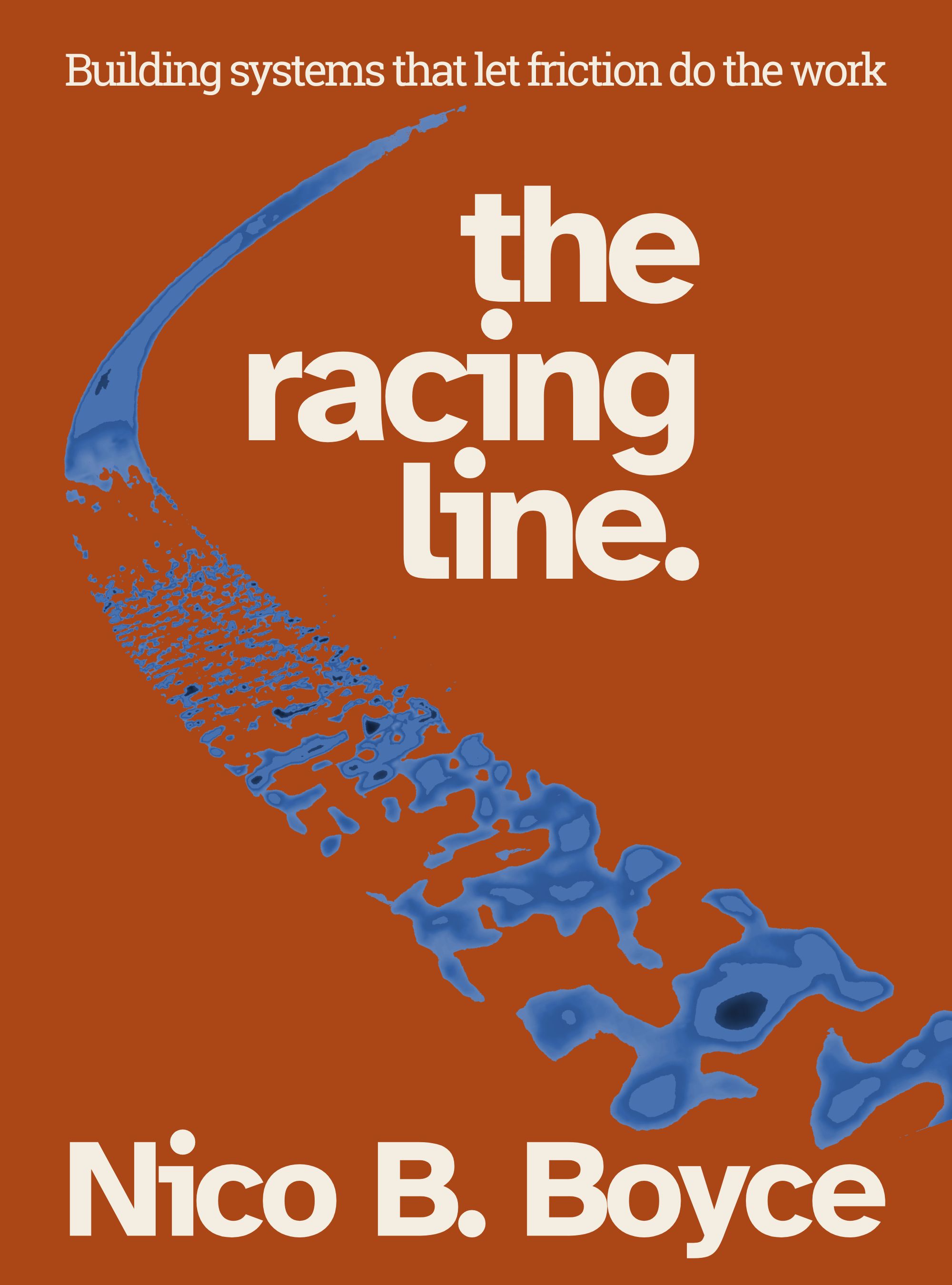
A new book from Nico B. Boyce
The Racing Line
Building systems that let friction do the work.
Coming soon. Register your interest and you'll be first to hear when it ships, with early-reader access for the people who put their hand up first.
What it's about
We are forever plodding along the winding paths of frustrating and inefficient systems: airport security, bank phone trees, job applications, the unavoidable processes that seem designed to make us angry. The truth is far worse: they were designed by accident.
The Racing Line is a book about designing with intention. It means thinking about how things happen, not just what they are. It's about understanding where to deploy friction and how to engineer experiences. Are you trying to cut the corner, or to maintain momentum?
Some processes were designed on purpose. Most just grew step by step, one workaround on top of the last, until the workarounds became the process.
The way things happen is part of the outcome. The hour between deciding to renew a passport and finishing the form is part of having a passport. The minutes between wanting a coffee and drinking one are part of the coffee.
Who it's for
If you're tired of everything we have to do feeling disjointed and brittle, you'll enjoy agreeing with the diagnosis. If you yourself shape processes the rest of us must navigate, you'll gain a great reference of examples and counterexamples perfect for justifying whatever it is you wanted to do anyway.
By the end you shouldn't be able to walk into a shop, a meeting, a restaurant, or a waiting room without asking the same questions. Was this designed with intention? Are the goals being achieved? Could there be a better racing line?
Where this comes from

Be first to read it
Register your interest and you'll be first to hear when it's ready.
Register interest