
Salto built the first serious configuration management product for Zendesk and showed the category was real. Deltastring shares most of its fundamentals and adds an MCP agent interface on top, so AI assistants can use the engine on your team's behalf through a safety envelope. Both are honest products. Here's where each fits today.
Last reviewed 08/06/2026.
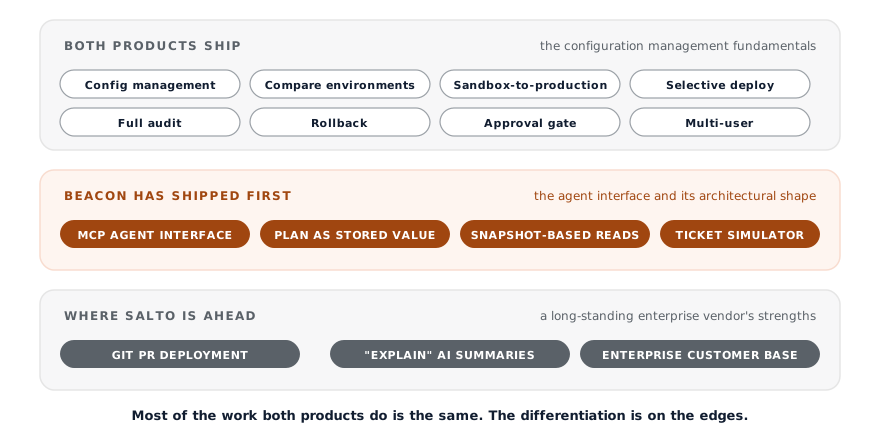
| Salto for Zendesk | Deltastring | |
|---|---|---|
| Configuration management | Yes | Yes |
| Compare environments | Yes | Yes |
| Sandbox-to-production deployment | Yes | Yes |
| Selective deployment | Yes | Yes |
| Audit trail | Yes, full | Yes, full |
| Rollback | Revert deployment, restore previous state | Token per apply, exact before-state |
| Approval gate for production | Release managers only | Named approver, self-review blocked |
| Git integration | PR-based deployment workflow | Webhook + REST API |
| AI features | "Explain" summaries plus a Claude Code plugin driving salto-cli | MCP agent interface that any MCP-compatible assistant can call |
| AI assistant scope | Claude Code only | Any MCP-compatible assistant |
| Pricing | Quote | Public |
Salto built this category for Zendesk before there was a category, and they did it carefully. The deployment workflow is sound: compare environments, select changes, deploy with credentials, optionally route through a Git PR for review. The audit captures who did what, when, and what the values changed from and to. The “release manager” role is a clean way to gate production deployments without inventing a complicated permissions model. We learned a lot from looking at what they shipped.
The customer list is serious. Enterprise sales motion, enterprise procurement, enterprise support. If your buying process is shaped by “what does the established vendor here look like”, Salto is the answer to that question today.
The “Explain” AI feature is a useful onboarding tool. It produces summaries of triggers and automations to help a new admin orient. It’s a read-side assistant inside Salto’s UI.
They’ve also recently published a Claude Code plugin that drives Salto’s CLI for Zendesk configuration workflows. It installs through Claude Code’s marketplace, runs salto-cli under the hood, and asks Claude to author and apply changes via Salto’s NACL declarative language. It’s a different shape from Deltastring’s MCP agent (covered below), and it’s relevant if your team already uses Claude Code as its AI surface specifically and is comfortable with Salto’s NACL workflow.
Two things that aren’t on Salto’s page.
An MCP agent interface, not a Claude Code plugin. Deltastring exposes its configuration management engine to AI assistants through the Model Context Protocol, which is an open standard. The agent can read your configuration (from Deltastring’s snapshot, not live Zendesk), propose changes in plain English, and route them through Deltastring’s apply engine. Sandbox writes are direct after confirmation. Production writes return an approval URL to Deltastring’s web app, where a named human approves; self-review is blocked at the route. The differences from Salto’s Claude Code plugin are real and matter for which AI assistant your team can use: Deltastring works with any MCP-compatible assistant (Claude Desktop, Claude Code, Cursor, ChatGPT and others); Salto’s plugin is wired into Claude Code’s plugin marketplace specifically. The writes also take different paths: Deltastring’s go through the plan/apply gate as a stored value; Salto’s go through the CLI’s apply with NACL as the source of truth. For the architectural argument behind the plan/apply gate, see Why you don’t want a direct-to-Zendesk MCP.
A plan/apply split as the operating model. Deltastring’s engine separates “describe the change” from “make the change” into two distinct operations. A plan is a stored value with a 72-hour TTL, consumed at most once. This shape exists for humans and agents both. It’s what makes the agent safe by construction rather than by promise: there is no apply path the agent can take for production without going through the gate.
Salto’s model is closer to “compare and deploy”, with the comparison and the approval as the controls. Both shapes work. The plan/apply split is what makes the agent layer possible.
The fundamentals of configuration management for Zendesk are similar. Compare instances. Selectively deploy. Track changes. Revert when needed. Both products take this seriously.
If you have a small team, a few Zendesks, and a deliberate cadence of config work, either product will handle the work well. The buying decision below this layer is about pricing, support, customer fit, and whether you want the agent layer.
The agent. If you have an AI assistant in your team’s workflow (Claude, ChatGPT, an internal tool, a developer environment) and you want it to be able to help with Zendesk configuration through MCP, Deltastring is the product that does that today. Salto’s “Explain” is a read-side feature in their UI; the AI doesn’t act as the agent.
The plan/apply split as a first-class concept. Salto deploys directly after comparison and approval. Deltastring’s plan is a stored, inspectable value with its own lifecycle. For a human user the difference is subtle. For an agent it’s the difference between a safe shape and a risky one.
You’re already running Salto and Salto is working. Deltastring’s MCP server doesn’t require leaving Salto. The agent talks to Deltastring. Deltastring talks to Zendesk. If Salto is your config management tool of record, Deltastring can sit alongside as the agent surface specifically, or you can move both to Deltastring. The decision to consolidate, if you make it, is downstream of whether the team wants the agent. The agent is the thing only Deltastring has today.